The Proto-Albanian script found in a tablet of Proto-Albanian land called Dodona begins with the Albanian language words:
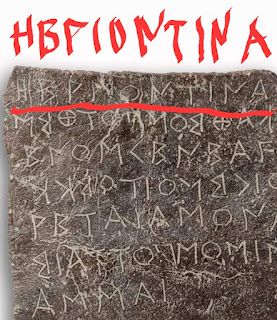
EBRIONTINA=
E BRION TI NA
It means "protect you us..."
Na=us
TI=You
Brion=protect
Na=us
TI=You
Brion=protect
Mbron is the Albanian word and *bron is in the Cham dialect of the Albanian language. It is related semantically with the word rroj (live, exist, last). *Rroj comes from Proto-Albanian *̥rē-, from Proto-Indo-European *Hreh₁- with Albanian formation with the prefix (a)n-.
The script has nothing to do with ancient "Greek". It's a different language, much older.
Just look at B's direction. Indicates that one line is read from left to right and the line below from right to left. We have two MM that does not occur in ancient "Greek". We have three consonants one after the other like BKK, RBT, BNB, which does not happen in ancient "Greek".
The Dodona lead tablets are a unicum in the ancient Proto-Albanian world dating from the 6th century BC to the middle of the 2nd century BC. They are small pieces of lead strips (measuring no more than 13.20 cm long and 6.70 cm wide), in which they are deciphered only by means of the Albanian language.
In total, more than 4,000 lead tablets have been discovered, scattered within the temenos of Dodona. The plates prove the writing of the old Albanian language. The plates are a group of findings that will not only provide a unique insight into the practice of the cult of the Oracle of the Albanians, but also the scientific validation of the old Albanian language.
This is the extraordinary memory of the proto-Albanian language.
The Dodona lead tablets are a unicum in the ancient Proto-Albanian world dating from the 6th century BC to the middle of the 2nd century BC. They are small pieces of lead strips (measuring no more than 13.20 cm long and 6.70 cm wide), in which they are deciphered only by means of the Albanian language.
In total, more than 4,000 lead tablets have been discovered, scattered within the temenos of Dodona. The plates prove the writing of the old Albanian language. The plates are a group of findings that will not only provide a unique insight into the practice of the cult of the Oracle of the Albanians, but also the scientific validation of the old Albanian language.
This is the extraordinary memory of the proto-Albanian language.


Comments
Post a Comment